The economy expanded by an estimated 4.5% in 2013, the fastest rate since the financial crisis. Oil and gas remain central to the success of the economy – the price of oil remains well above US$100 per barrel and the UAE is thought to have the seventh largest reserves in the world (98bn barrels) – accounting for close to 50% of total exports.
Dynamic businesses at the forefront of M&A activity highlights an increasing importance for M&A in driving growth. There is a clear acknowledgment from the 12,500 businesses surveyed that acquisitions will be needed to supplement existing operations.
24%: that is the proportion of women holding the most senior roles in businesses across the globe.
Developers, property companies, investors and homeowners suffered disproportionately during the financial crisis. But now, finally, expectations for profitability, jobs and orders are all on the rise.
The role of leaders in creating successful businesses and driving growth is crucial. How these leaders run their teams and make decisions can be the difference between success and failure. But do the leadership characteristics displayed by leaders vary from region to region?
The next 12 months hold a number of opportunities and challenges for Latin America. An estimated 600,000 visitors will descend on Brazil for the FIFA World Cup. They will be joined by television viewers across the globe as Brazil attempts to show the world that despite stadia construction delays and social unrest during the Confederations Cup last summer, it is open for business.
Drawing on data and insight from the Grant Thornton International Business Report (IBR), the Economist Intelligence Unit (EIU) and the International Monetary Fund (IMF), The global economy in 2014 answers these questions and more.
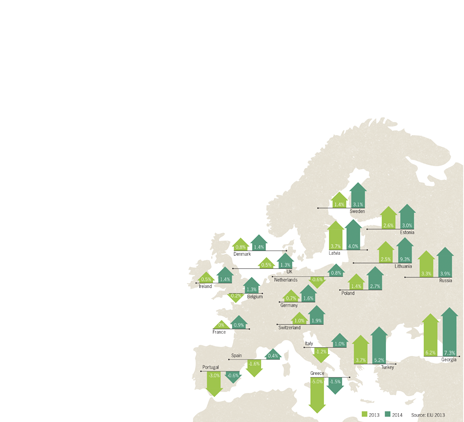
The economy of France continues to suffer as the eurozone crisis continues. Following a deep contraction in 2009, the economy recovered robustly, posting seven consecutive quarters of expansion. However, France has stagnated over the past two years as problems in southern Europe intensified, with growth slowing as unemployment and government debt rise.
Presidential elections in some of the world’s largest economies, the sovereign debt crisis and the US fiscal cliff have all contributed to a global sense of economic uncertainty. How are major and developing markets faring in the face of these developments and what does the year ahead have in store?
In the second of our Future of Europe series, we look at three aspects of the sovereign debt crisis: the stagnation of the region’s economies, closer integration and the future expansion of Europe.
These are the results of the Grant Thornton Global Dynamism Index (GDI) 2013, an annual research project designed by the Economist Intelligence Unit, which ranks the development of the business growth environments of 60 of the world's largest economies over the past 12 months.
Recovery from the financial crisis remains uncertain across both mature and emerging markets. During the past 12 months we have seen volatile commodity prices, disruptions in supply chains, political uprisings and natural disasters.